Airbnb Profit Calculator: What a Short-Term Rental Really Makes in 2026
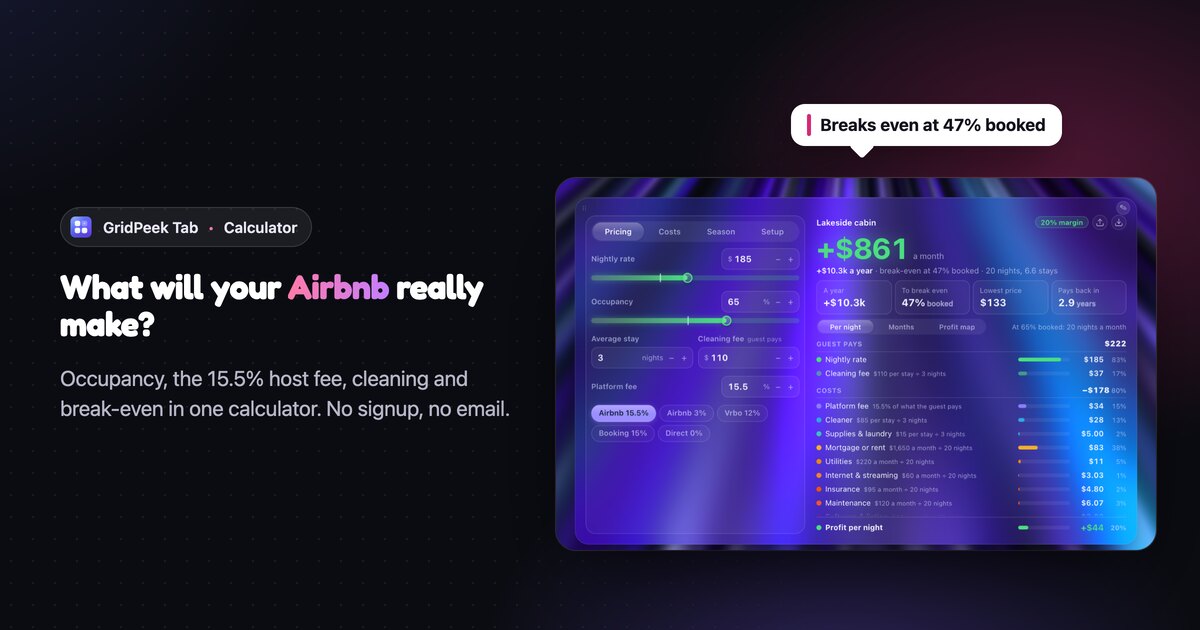
Most Airbnb calculators tell you what a place could earn. Very few tell you what you'd keep. That gap is where hosts get surprised: a cabin that books $4,386 in a month can leave you $861 after Airbnb's 15.5% host fee, cleaning and bills, and almost nothing if you add a 20% co-host.
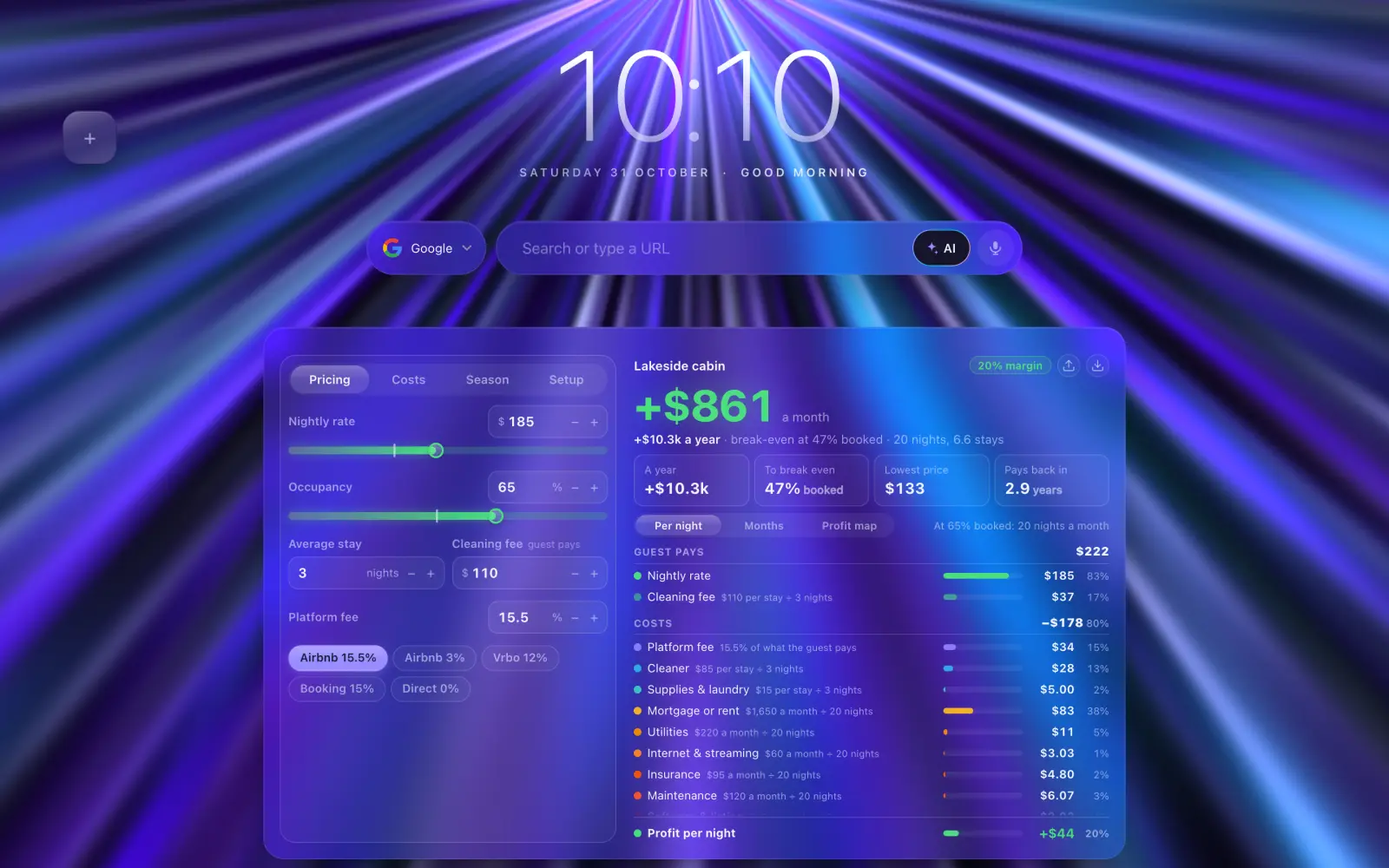
This guide shows the exact math, a full worked example, the break-even occupancy most calculators skip, and how to run your own numbers in Rental Profit, a calculator widget in GridPeek Tab, our Chrome new tab extension. It works from your numbers, not an address, and it doesn't ask for an email or a phone number before showing results.
How do you calculate Airbnb profit?
Here is the whole formula, month by month. It's the same one Rental Profit uses.
- Booked nights = occupancy × 30.4 nights
- Stays = booked nights ÷ average length of stay
- Income = booked nights × nightly rate + stays × cleaning fee
- Platform fee = fee % × income (Airbnb and Vrbo both charge on the cleaning fee too)
- Management = management % × nightly income, if you use a co-host or manager
- Turnover costs = stays × (what you pay the cleaner + supplies and laundry)
- Profit = income − platform fee − management − turnover costs − fixed monthly bills
Two things trip people up. First, cleaning is both income and a cost: guests pay your cleaning fee, you pay your cleaner, and the platform takes its cut of the fee in between. Second, the number of stays matters as much as the number of nights. Twenty nights as seven short stays costs you seven turnovers. Twenty nights as two long stays costs you two.
How much does Airbnb charge hosts in 2026?
This changed this year, and plenty of calculators online still use the old numbers.
- Airbnb: 15.5% for most hosts. Airbnb says it "moved from a split fee to a single fee structure in 2026", with "a single 15.5% fee, paid by hosts" that "applies to your nightly price and any optional fees you add, like a cleaning or pet fee." Listings in Brazil and Mexico pay 16%.
- The 3% split fee is on its way out. Airbnb's help center says "the split-fee structure is being phased out." If you're still on it, you pay about 3% and guests pay a separate service fee on top.
- Vrbo: 12%. Vrbo's help center says "a 12% commission rate is charged on the rental amount and any additional fees you charge to the traveler," like cleaning, and there's no separate payment processing fee when Vrbo processes the payment.
Fees checked on 31 October 2026. Your exact rate is in your Airbnb or Vrbo dashboard, so use that if it differs.
A pricing tip that falls out of this: if you want to net $160 a night on Airbnb, list it at $160 ÷ (1 − 0.155) ≈ $189, not $160.
What does a short-term rental really make? A worked example
Here's a realistic cabin, run through the calculator exactly as you'd enter it.
| Input | Value |
|---|---|
| Nightly rate | $185 |
| Occupancy | 65% |
| Average stay | 3 nights |
| Cleaning fee guests pay | $110 per stay |
| Cleaner + supplies you pay | $85 + $15 per stay |
| Platform fee | Airbnb, 15.5% |
| Monthly bills | $2,185 (mortgage $1,650, utilities $220, internet $60, insurance $95, maintenance $120, software $40) |
And the month it produces:
| Line | Per month |
|---|---|
| Booked nights | 19.8 nights in 6.6 stays |
| Guests pay you | $4,386 |
| Airbnb host fee (15.5%) | −$680 |
| Cleaning and supplies | −$659 |
| Fixed bills | −$2,185 |
| Profit | $861 |
That's about $10,300 a year before income tax, and break-even comes at about 47% booked. Put the $30,000 you spent furnishing it into the Setup tab, and the widget shows it paying back in about 2.9 years.
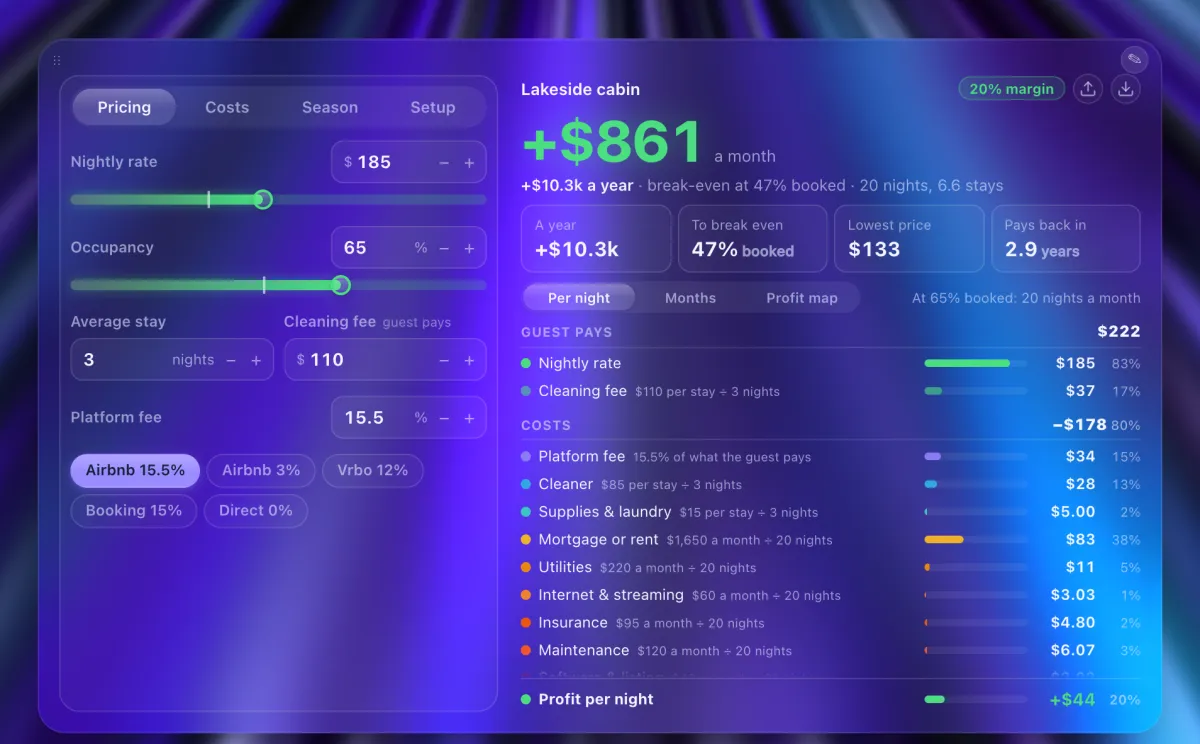
Now look at what one booked night does. Guests pay about $222 for it (the $185 rate plus that night's share of the cleaning fee). Airbnb takes $34, cleaning and supplies take $33, and that night's share of the bills is $110. You keep about $44. The Per night view lays this out line by line:
How much do fees and a manager change it?
Same cabin, same bookings, different fee setups:
| Setup | Profit a month | Break-even |
|---|---|---|
| Airbnb split fee (3%, being phased out) | $1,409 | 40% booked |
| Vrbo (12%) | $1,015 | 44% booked |
| Airbnb host fee (15.5%) | $861 | 47% booked |
| Airbnb 15.5% + a 20% co-host | $129 | 61% booked |
Moving from the 3% split fee to the 15.5% host fee costs this cabin about $550 a month. Adding a co-host at 20% of the nightly income nearly wipes out the profit. That's not a reason to avoid managers, since a good one may raise your rate and occupancy. It's a reason to run the numbers with their fee in before you sign.
What occupancy do you need to break even?
Break-even is the single most useful number for a short-term rental, and most calculators don't show it.
Break-even occupancy = fixed monthly bills ÷ (profit per booked night before bills × 30.4)
For the cabin, each booked night leaves about $110 before bills (the $185 rate after the 15.5% fee, plus its share of the cleaning fee after fees, minus the cleaner and supplies). $2,185 ÷ ($110 × 30.4) ≈ 47%.
Here's what that means across occupancy levels:
| Occupancy | Profit a month |
|---|---|
| 50% | $158 |
| 55% | $393 |
| 60% | $627 |
| 65% | $861 |
| 70% | $1,096 |
| 75% | $1,330 |
Every 5 points of occupancy is worth about $235 a month here. The Profit map view shows this as a grid of occupancy against nightly rate, so you can see whether you'd rather drop the price to fill nights or hold it:
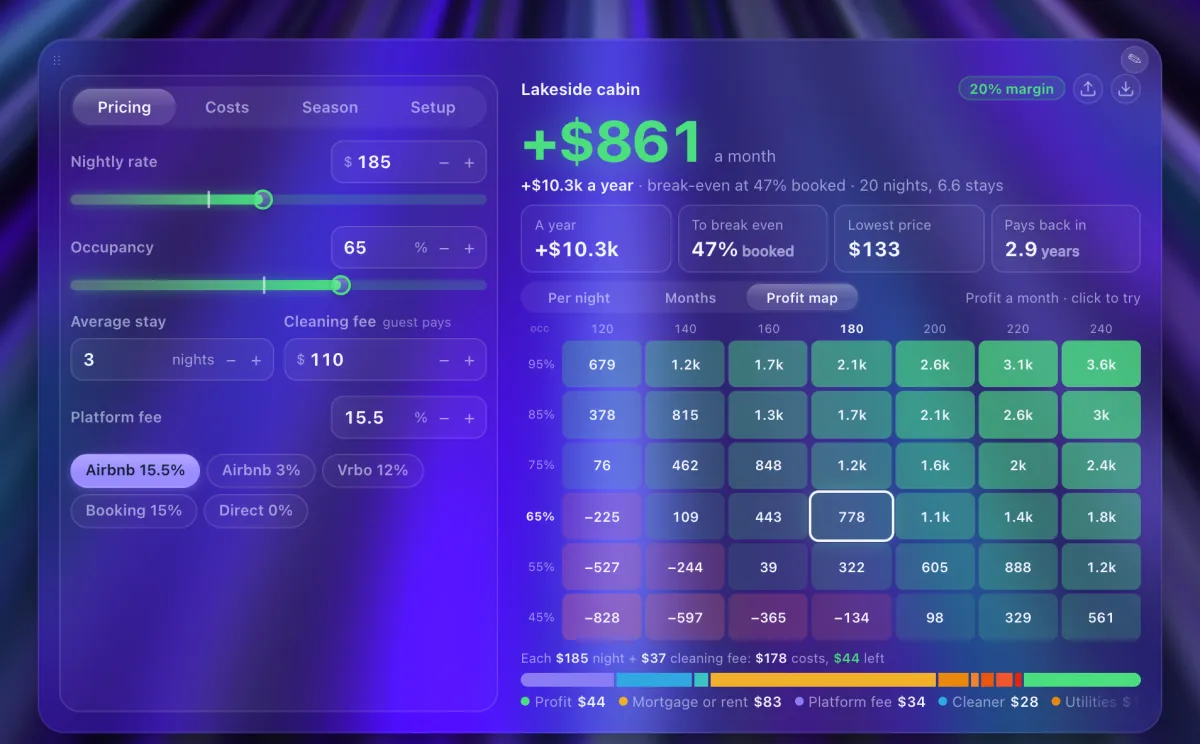
The widget also shows the lowest price that still breaks even at your occupancy. For the cabin it's about $133 a night, which is handy when you're tempted to cut rates in a slow week.
Why the average month hides your worst months
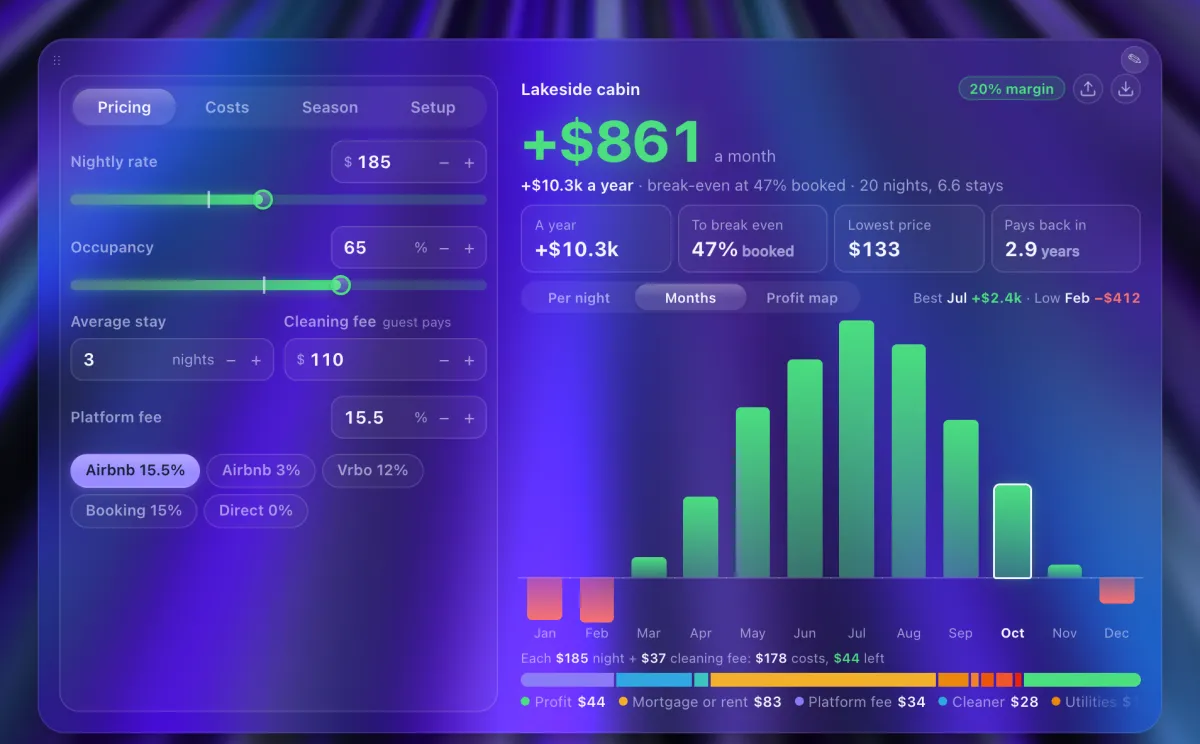
Almost every rental is seasonal, and an "average month" quietly hides the ones that lose money. Rental Profit's Season tab spreads your bookings over the year around your busiest month, while keeping the same yearly occupancy and average rate.
With strong seasonality and July as the peak, the cabin makes about $2,351 in July and loses about $412 in February. The year still adds up to roughly $10,300, but you need the cash to carry the winter.
Which costs do most Airbnb calculators leave out?
Address-based estimators mostly stop at revenue. Before you trust a profit figure, make sure it includes:
| Cost | How to enter it |
|---|---|
| Platform fee | 15.5% Airbnb, 12% Vrbo, 0% for direct bookings |
| Cleaner per turnover | What you actually pay per stay, not the fee guests pay |
| Supplies and laundry | Per stay: toiletries, coffee, linen service |
| Management or co-host | % of nightly income, if you use one |
| Mortgage or rent | Monthly. If you rent the place to sublet, this is your rent |
| Utilities and internet | Monthly, including streaming accounts |
| Insurance | Monthly. Many standard homeowner policies don't cover short-term rentals, so ask about a short-term rental policy |
| Maintenance reserve | A monthly amount set aside for repairs |
| Property tax and HOA | Monthly share |
| Software | Pricing tools, channel managers, smart locks |
| Furnishing and setup | One-off: goes in Setup cost for the payback figure |
On management, quotes vary a lot with what's included. Industry guides put full-service short-term rental management commonly at 15% to 40% of booking revenue. Use the real quote you have.
Occupancy and lodging taxes are usually charged to the guest on top of your price. In some places Airbnb collects and pays them for you, and in others you have to do it yourself, so check the rules for your city.
How to calculate your rental's profit in GridPeek Tab
- Add GridPeek Tab to Chrome. It also installs in Edge and Brave.
- Open a new tab, press N (or click + Add), choose Money & admin, then Rental Profit.
- In Pricing, set your nightly rate, occupancy, average stay and cleaning fee, and tap your platform: Airbnb 15.5%, Airbnb 3%, Vrbo 12%, Booking 15% or Direct 0%.
- In Costs, replace the sample bills with yours, and set what your cleaner and supplies cost per stay.
- In Season, pick how seasonal the place is and its busiest month.
- In Setup, name the property, pick your currency and, if you like, add your setup cost to see the payback time.
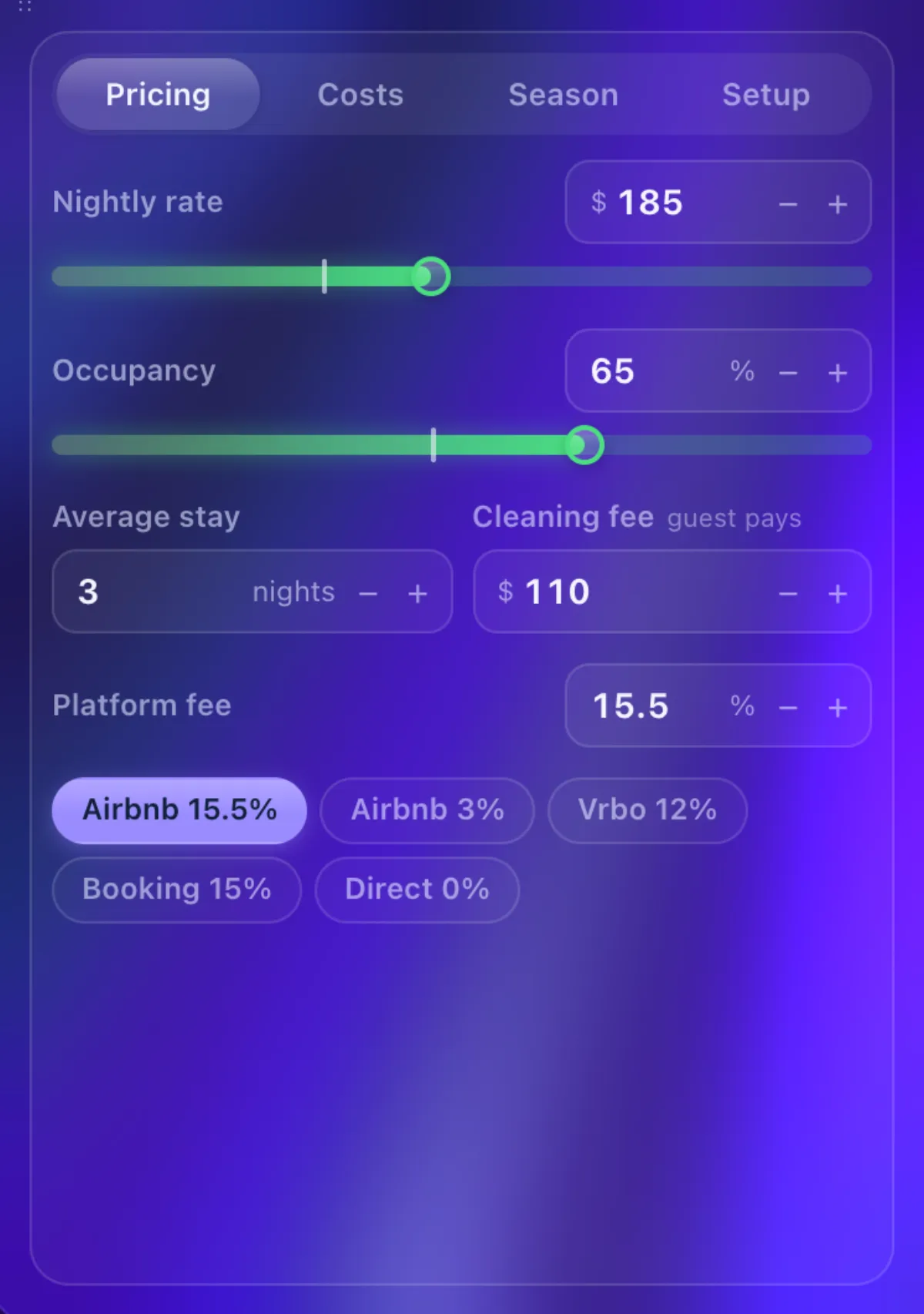
Everything updates as you type. You can save the result as a CSV for a spreadsheet, or as a file you can load back later to compare two properties.
Because it lives in your new tab, the numbers are there every time you open the browser. That turns out to be the useful part: when Airbnb suggests a lower price or a co-host sends a proposal, you can check what it does to your profit in five seconds instead of rebuilding a spreadsheet.
How is this different from AirDNA, Awning or Mashvisor?
They answer a different question. Address-based tools like Awning's calculator and AirDNA's Rentalizer estimate what a property could earn from market data: likely nightly rate, occupancy and revenue for an address. That's valuable when you're choosing a market or a property.
Rental Profit answers what you'll keep from your own numbers, after every fee and bill, with break-even and payback. The two work well together: take a market tool's estimate of nightly rate and occupancy, put it into Rental Profit, and see if the deal still works after the 15.5% fee, cleaning and your mortgage.
| Address-based estimators | Rental Profit in GridPeek Tab | |
|---|---|---|
| Starts from | An address | Your nightly rate, occupancy and bills |
| Main output | Estimated revenue | Profit after every cost |
| Break-even occupancy and lowest price | Rarely | Yes |
| Seasonality by month | Some | Yes |
| Asks for email or phone | Often, for full reports | Never |
| Where your numbers go | Their servers | Stay in your browser |
How much can you make on Airbnb?
Honestly, nobody can give you one number, and you should be wary of anyone who does. It depends on the market, the property, your pricing and your costs. What you can do is get to a reliable answer in three steps:
- Estimate the nightly rate and occupancy from comparable listings near you, or from a market-data tool.
- Put in your real costs, especially the mortgage or rent, cleaning and the 15.5% fee.
- Check the gap between your occupancy and break-even. A place that breaks even at 47% and books 65% has room to absorb a bad month. One that breaks even at 61% doesn't.
What this calculator can't tell you
- It doesn't know your market. It won't predict your nightly rate or occupancy. You bring those numbers.
- Profit is before income tax. How your rental income is taxed depends on your situation, so talk to a tax professional.
- It doesn't check local rules. Many US cities require permits, limit short-term rentals or ban them in some zones. Check before you buy.
Run your own numbers
The cabin in this guide is just an example. Your rate, your bills and your fee are what decide whether a rental is worth it.
GridPeek Tab has 66 widgets in total. If you're curious what else is in there, here's the full tour of every widget and tool.
Frequently Asked Questions
How do you calculate Airbnb profit?
Take what guests pay for the month (booked nights times your nightly rate, plus cleaning fees), then subtract the platform fee, any management fee, cleaning and supplies for each stay, and your fixed monthly bills like the mortgage, utilities and insurance. What's left is your profit before income tax. Booked nights are your occupancy times about 30.4 nights.
How much does Airbnb charge hosts in 2026?
Most hosts pay a single 15.5% host fee, according to Airbnb's own help pages. It applies to your nightly price and fees you add, like cleaning. Airbnb says the old 3% split fee is being phased out, and listings in Brazil and Mexico pay 16%.
What occupancy do I need to break even on Airbnb?
Divide your fixed monthly bills by what one booked night leaves you after its costs, then divide by about 30.4. In our example cabin, $2,185 of monthly bills and about $110 left per booked night means breaking even at about 47% occupancy. Below that, the month loses money.
What is a good profit margin for an Airbnb?
There's no single number, because it depends on whether you own outright, have a mortgage or rent the place. A useful check is the gap between your occupancy and your break-even occupancy: the bigger that gap, the more a slow month or a fee change can hit you before you lose money.
Is the GridPeek Tab rental calculator free?
Rental Profit is a Pro widget in GridPeek Tab. You can use it free for 7 days with no card and no account, and after that Pro costs $2.99 a month, $19.99 a year or $49 once. Your numbers stay in your browser.
Does the calculator need my address?
No. It works from your own numbers: nightly rate, occupancy, fees, cleaning and bills. If you want market data for an address you're thinking of buying, use a market-data tool to estimate the nightly rate and occupancy, then put those numbers into the calculator to see the profit after every cost.
Does Vrbo charge less than Airbnb?
Vrbo's help center says it charges a 12% commission on the rental amount and fees like cleaning, with no separate payment processing fee when Vrbo processes the payment. Airbnb's standard host fee is 15.5%. On our example cabin, that difference is worth about $150 a month.
About the author
GridPeek Team
The GridPeek team builds free, in-browser tools for Instagram creators (grid planning, image splitting, watermarking, background removal, hashtag generation, image blurring, and profile picture preview) and shares practical resources and articles to help creators grow.
Related Tool Suite
Build a Complete 2026 Content Workflow
Need related tools? Use this connected stack to plan your grid, split carousel visuals, watermark brand content, remove logo backgrounds, generate hashtags, and blur sensitive details with modern creator-ready UX.